Most people talk about “RAG” as if it’s one thing.
But there are actually very different levels of Retrieval-Augmented Generation systems — and understanding the difference matters when building AI applications.
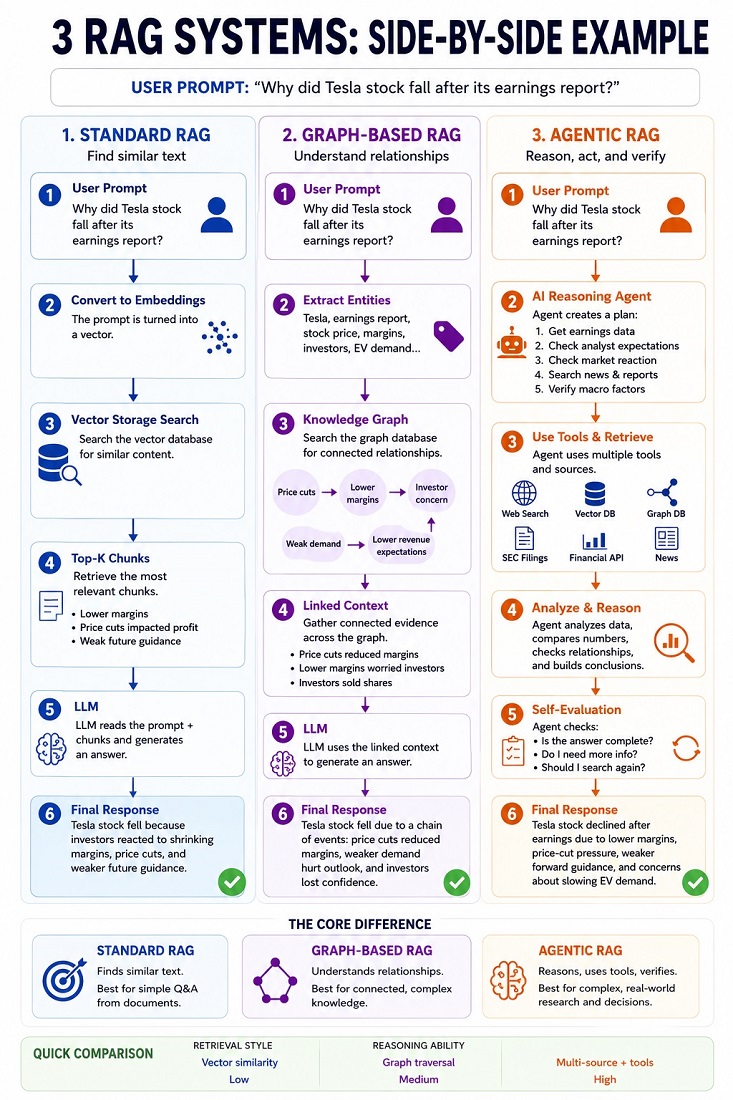
👇 This visual breaks down 3 common RAG architectures using the same example prompt.
First, what is RAG?
RAG (Retrieval-Augmented Generation) is an AI architecture that allows an LLM to retrieve external information before generating a response.
Instead of relying only on its training data, the AI can access:
• documents
• vector databases
• company knowledge bases
• APIs
• web search
• external tools
This makes AI systems:
✅ more accurate
✅ more up-to-date
✅ more context-aware
✅ more useful for real-world business tasks
Why does this matter?
Because raw LLMs often:
- hallucinate,
- lack current information,
- miss company-specific knowledge,
- and struggle with complex reasoning.
RAG systems are becoming the foundation of enterprise AI because they connect language models to real-world data and workflows.
The illustration compares:
🔹 Standard RAG
Finds semantically similar content from vector databases.
🔹 Graph-Based RAG
Understands relationships between entities using knowledge graphs.
🔹 Agentic RAG
Uses reasoning agents, tools, APIs, search, and self-evaluation to solve more complex tasks.
The major evolution happening in AI systems is:
📄 From simple retrieval
➡️
🧠 Toward reasoning, planning, and autonomous decision support
We’re moving from “search + summarize” systems to AI systems that can:
- analyze,
- verify,
- reason,
- use tools,
- and adapt dynamically.
Which architecture do you think will become the dominant model for enterprise AI?
#AI #RAG #GenerativeAI #LLM #ArtificialIntelligence #MachineLearning #AIAgents #KnowledgeGraphs #EnterpriseAI #AIEngineering