
Two AI Economies, Two Models
Artificial intelligence is reshaping the global digital economy, but it is not doing so uniformly.
The United States and the European Union represent two distinct economic models of AI adoption, shaped by different approaches to innovation, regulation, labor markets, and governance.
Understanding these differences is critical for:
-
Businesses deciding where to invest or expand
-
Entrepreneurs considering relocation
-
Organizations designing AI strategies across borders
This article compares how AI is transforming the US and EU economies, and what those differences mean in practice.
1. AI as a General-Purpose Technology: Same Engine, Different Systems
Both the US and EU recognize AI as a general-purpose technology, but their economic systems absorb it differently.
-
US model:
Market-driven, venture-capital fueled, rapid experimentation -
EU model:
Institution-driven, regulation-aware, long-term risk management
Economically, this means:
-
Faster commercialization in the US
-
Slower but more controlled diffusion in the EU
2. Investment and Scale: Where AI Capital Concentrates
📊 Graphic: Relative AI Investment Intensity (US vs EU)
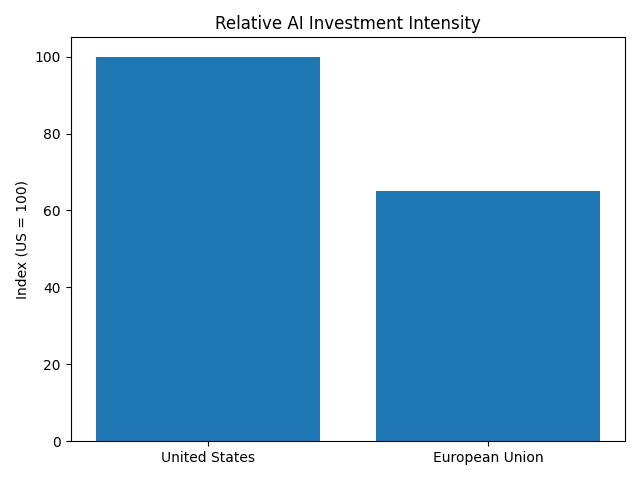
The US dominates global private AI investment, driven by:
-
Large technology platforms
-
Deep venture capital markets
-
Defense and public–private partnerships
The EU invests less aggressively but spreads funding across:
-
Research institutions
-
SMEs
-
Public-interest applications
Economic implication:
The US gains speed and scale; the EU gains diversity and institutional resilience.
3. Regulation as an Economic Variable, Not a Constraint
📊 Graphic: AI Regulatory Intensity (US vs EU)
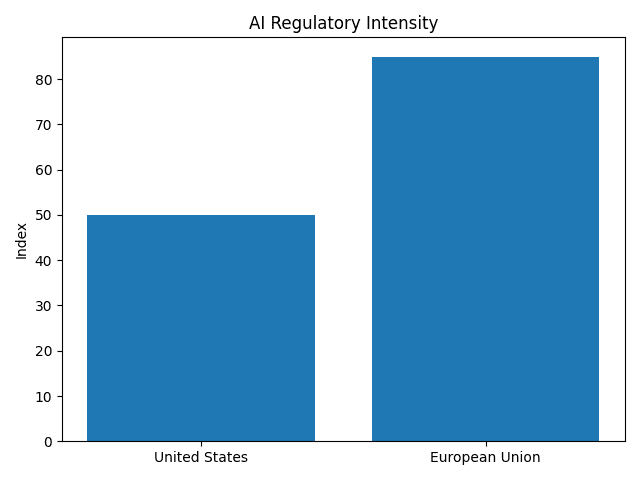
Regulation is often framed as an obstacle, but economically it functions as a market-shaping force.
-
EU:
AI Act prioritizes trust, accountability, and risk classification -
US:
Sector-based, flexible, innovation-first approach
For organizations:
-
The EU reduces long-term uncertainty
-
The US enables rapid deployment and iteration
This divergence increasingly influences where companies choose to locate AI activities.
4. Labor Markets and Productivity Effects
📊 Graphic: Labor Market Flexibility (US vs EU)
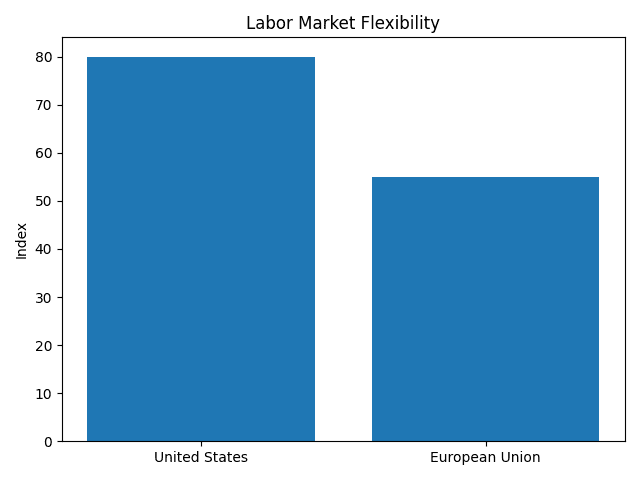
AI’s productivity impact is mediated by labor institutions.
-
US labor markets:
Flexible, faster task reallocation, higher short-term displacement -
EU labor markets:
Strong protections, slower adjustment, more emphasis on retraining
Economic outcome:
-
US firms adapt faster
-
EU firms emphasize social stability and long-term skills development
This directly affects:
-
Hiring strategies
-
Remote work models
-
Cross-border team design
5. Decision Costs and Competitive Advantage
AI reduces the cost of economic decision-making, but institutional context matters.
-
US firms optimize for speed and scale
-
EU firms optimize for compliance and sustainability
In global competition:
-
Speed favors the US
-
Trust and regulatory alignment favor the EU
Smart organizations design hybrid strategies, using AI to:
-
Test markets quickly (US-style)
-
Deploy responsibly at scale (EU-style)
6. AI, Inequality, and Regional Divergence
AI risks amplifying economic divergence:
-
Between firms
-
Between regions
-
Between countries
The US risks winner-takes-most dynamics.
The EU risks innovation bottlenecks.
Economically, success depends on:
-
Education systems
-
Mobility policies
-
Data infrastructure
-
Institutional trust
7. Strategic Implications for Businesses and Entrepreneurs
For globally mobile organizations and founders, the EU–US contrast matters:
| Decision Area | US Advantage | EU Advantage |
|---|---|---|
| Speed to market | ✅ | |
| Regulatory clarity | ✅ | |
| Capital access | ✅ | |
| Talent stability | ✅ | |
| Trust-based sectors | ✅ |
AI-assisted economic analysis allows these trade-offs to be evaluated dynamically.
8. AI Readiness as a Comparative Advantage
AI readiness differs across regions:
-
In the US: readiness = speed + data + scale
-
In the EU: readiness = governance + skills + alignment
Organizations operating across both regions need region-specific AI strategies, not one-size-fits-all deployments.
Conclusion: Two Paths, One Global Economy
The US and EU are not competing AI futures — they are co-evolving economic models.
Organizations that understand both:
-
Gain strategic flexibility
-
Reduce regulatory risk
-
Improve long-term returns on AI investment
AI is not just a technological shift; it is an economic design choice shaped by institutions, markets, and values.
Planning AI adoption, relocation, or market entry across the US and EU?
Start with an AI Readiness Assessment grounded in economics and global strategy.